Fez to Casablanca Train: Complete Guide to Routes, Schedules, Prices & Tips (2026)
The Fez to Casablanca train is the most practical way to travel between Morocco’s spiritual capital and its economic powerhouse. Operated by ONCF (Office National des Chemins de Fer), this 377-kilometre rail corridor carries thousands of passengers daily — from tourists exploring the Fez medina to business commuters heading to Casablanca’s financial district. With journey times ranging from 3 hours 35 minutes on the fastest direct services to 4 hours 45 minutes on slower trains, and tickets starting at just 150 MAD (about $15 USD), the train consistently outperforms the bus on speed and the car on convenience. This complete guide covers daily schedules, ticket pricing, step-by-step booking instructions, comparisons with alternative transport, and insider tips that will save you time and money. Whether you’re a first-time visitor or a seasoned traveller, this is your definitive resource for rail travel between these two remarkable cities.
Key Takeaways
- The direct Fez to Casablanca train takes approximately 3.5 to 4.5 hours, covering 377 km, with 8–10 direct departures daily operated by ONCF.
- Second-class tickets cost between 150–250 MAD (approx. $15–$25 USD), while first class ranges from 250–400 MAD — booking in advance is not required but recommended for peak season.
- Most trains arrive at Casa Voyageurs station, the main hub, with connections to the Casablanca tram network and onward trains.
- There is no Al Boraq high-speed service on this route — the TGV only runs between Casablanca and Tangier — so standard Intercity trains are the only rail option.
- Travellers can choose between direct trains and those requiring a transfer at Sidi Kacem or Kenitra — direct trains save roughly 40–60 minutes.
The Complete Answer: What You Need to Know About the Fez to Casablanca Train
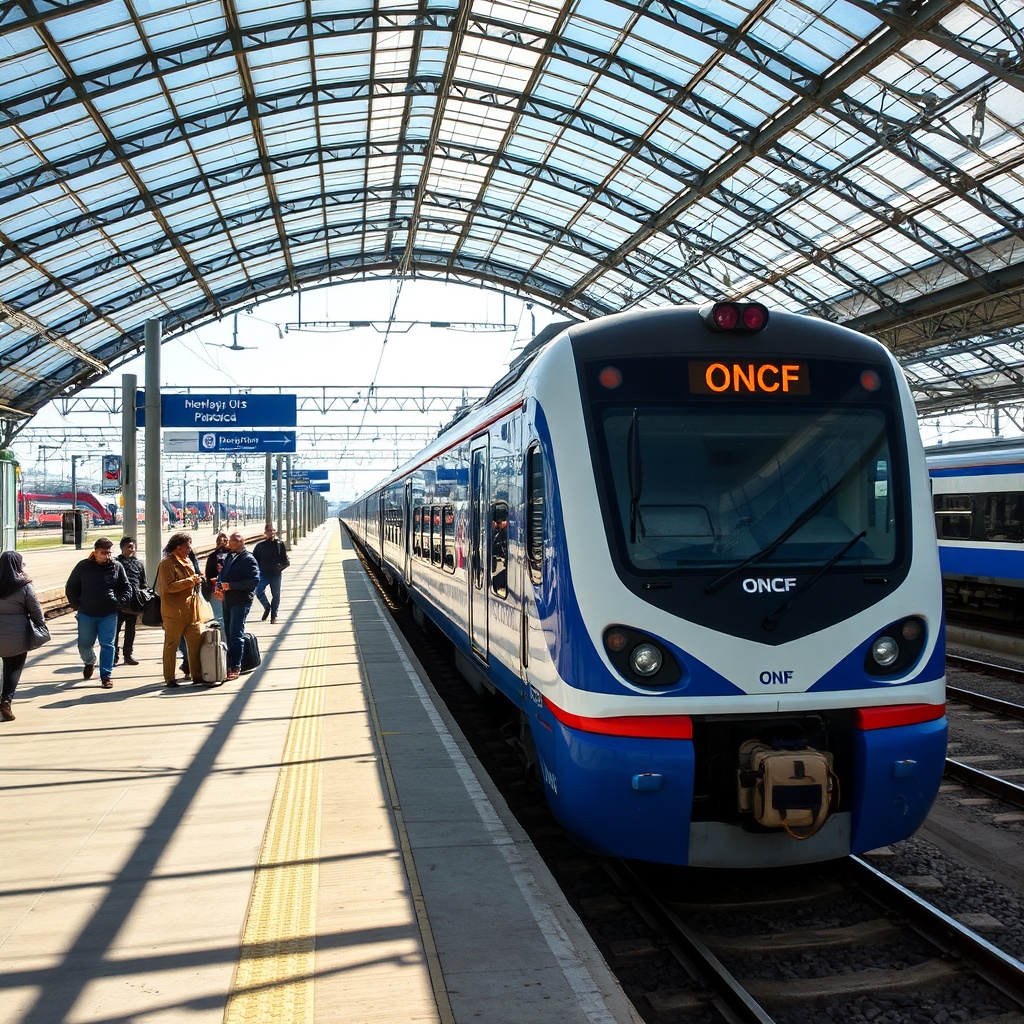
A view of the intercity train at the main Casablanca station, capturing the bustling departure atmosphere.
ONCF operates daily intercity trains from Fez Ville Nouvelle station to Casablanca Voyageurs, with journey times ranging from 3 hours 35 minutes on the fastest direct service to 4 hours 45 minutes on slower trains with additional stops. Trains run from approximately 5:10 AM to 9:30 PM, with departures roughly every 1.5 to 2 hours throughout the day. All services on this corridor are standard intercity trains — there is no high-speed option connecting these two cities.
Quick Answer: The Fez to Casablanca train departs from Fez Ville Nouvelle station and arrives at Casa Voyageurs, taking 3 hours 35 minutes to 4 hours 45 minutes depending on the service. ONCF runs 8–10 direct trains daily between approximately 5:10 AM and 9:30 PM, with second-class fares from 150 MAD and first-class from 250 MAD.
Direct Trains vs. Transfer Services
Two service types operate on this route. Direct trains (8–10 per day) run Fez → Sidi Kacem → Kenitra → Casa Voyageurs without requiring any change. Connecting services, by contrast, require passengers to transfer at Kenitra or Sidi Kacem onto a different train. Direct trains save 40–60 minutes compared to connections but tend to sell out faster, especially on Friday evenings and Sunday afternoons. Some direct trains continue past Casa Voyageurs to terminate at Casa Port, the downtown station closer to the city centre.
A glimpse of the picturesque landscape seen from the train, highlighting the comfortable travel experience.
Journey Time Breakdown
The route splits into three main segments. Fez to Sidi Kacem takes approximately 1 hour 15 minutes; Sidi Kacem to Kenitra adds about 45 minutes; and Kenitra to Casablanca Voyageurs takes roughly 1 hour 30 minutes. That’s a total distance of 377 km at an average speed of 85–105 km/h — slower than the Al Boraq high-speed line serving other Moroccan cities, but perfectly comfortable and reliable for a cross-country journey.
Ticket Classes and Pricing
Fares are structured around two main classes. Second-class seats cost 150–250 MAD ($15–$25 USD) and feature bench-style seating in compartments of 8. First-class compartments cost 250–400 MAD ($25–$40 USD) and seat 6 passengers with significantly more legroom; newer carriages on select services include air conditioning and electrical outlets. Children under 4 travel free, ages 4–12 receive a 50% discount, and ONCF offers a 50% reduction for students under 26 with a valid ISIC card.
Definition: ONCF — Office National des Chemins de Fer, Morocco’s state-owned national railway operator, running all intercity, regional, and high-speed train services across the country since 1963.
Step-by-Step: How to Book Your Train Ticket
Booking is straightforward whether you prefer online or in-person methods. The entire process takes under five minutes online, and e-tickets are accepted directly on your phone.
Step-by-Step Booking Process
- Visit the official ONCF website (www.oncf.ma) or download the ONCF mobile app — available in French, Arabic, and English.
- Select your route: departure station « Fès Ville Nouvelle » and arrival station « Casablanca Voyageurs » (or « Casa Port » if you prefer that terminal).
- Choose your travel date and preferred departure time — the system displays all available trains with live seat availability.
- Select your class (second, first, or first+ with extra amenities) and the number of passengers.
- Pay online using a credit card, or choose « pay at station » to collect tickets at a vending machine or counter.
- Present your e-ticket (PDF or QR code) or printed ticket to the conductor when boarding — no passport control or ID check is required for domestic routes.
Buying at the Station
Ticket counters at Fez Ville Nouvelle open from 5:30 AM to 10:00 PM, with self-service kiosks accepting both cash and cards. Buying same-day is generally fine outside of summer (July–August) and Eid holidays, when advance booking is strongly advised. During peak periods, counters can have queues of 15–20 minutes, so factor that into your arrival time.
Onboard Experience and Amenities
All intercity carriages are air-conditioned, with luggage racks at the ends of each carriage and a snack trolley on most services offering coffee, tea, sandwiches, and pastries. Toilets are clean and maintained at major stops. First-class compartments seat 6 passengers with more legroom; second class seats 8 per compartment. Electrical outlets are available in newer carriages on select services — check the carriage number when boarding if you need to charge devices.
Quick Answer: Booking your train ticket takes about 5 minutes online via the ONCF website or mobile app. Choose your stations, date, and class, then pay by card or select « pay at station. » E-tickets are scanned from your phone — no printing or ID required for domestic travel.
Fez to Casablanca Train Schedules: Departure Times and Frequency
ONCF runs 8–10 direct trains daily in each direction, with the first departure at approximately 5:10 AM and the last at approximately 9:30 PM. Peak morning departures (7:00–9:00 AM) and early evening departures (4:00–6:00 PM) are the busiest — book ahead if travelling during these windows.
Typical Daily Schedule (2026)
Representative departure times from Fez Ville Nouvelle include: 5:10 AM, 7:15 AM, 9:30 AM, 11:45 AM, 1:30 PM, 3:20 PM, 5:00 PM, 6:45 PM, 8:15 PM, and 9:30 PM. The 7:15 AM and 5:00 PM departures are the fastest, completing the journey in under 3 hours 45 minutes. Schedules are subject to seasonal adjustments — always check the ONCF app for real-time updates before heading to the station.
Seasonal Variations and Holiday Schedules
During Ramadan, departure times shift by 30–60 minutes to accommodate iftar timing. In summer (June–September), ONCF adds extra trains to handle tourist demand. On major holidays like Eid al-Fitr and Eid al-Adha, the railway publishes a special timetable — check at least 2 weeks in advance and book early, as trains fill up quickly.
Connecting to the Al Boraq High-Speed Line
The Al Boraq TGV does NOT serve Fez. However, you can connect at Kenitra: take a Fez–Kenitra train (approximately 2 hours), then board the Al Boraq to Casablanca (25 minutes) or Tangier (35 minutes). This connection is useful for travellers heading to Tangier or Rabat but is not recommended for Casablanca-bound passengers, since the direct train is faster and simpler.
Definition: Al Boraq — Morocco’s high-speed rail service operated by ONCF, running at up to 320 km/h between Tangier, Kenitra, Rabat, and Casablanca. It does not serve Fez.
Fez to Casablanca Train vs. Bus, Car, and Flight: Which Is Best?
The train is the best all-round option for most travellers, but your choice depends on budget, group size, and flexibility. Here’s how the four main transport modes stack up.
Comparison Table: Train vs. Bus vs. Car vs. Flight
| Transport Mode | Duration | Cost (approx.) | Frequency | Comfort | Reliability |
|---|---|---|---|---|---|
| **Train (ONCF)** | 3h 35m – 4h 45m | 150–400 MAD | 8–10 daily | Good — air-con, legroom | High — punctual (85–95% on-time) |
| **Bus (CTM, Supratours)** | 5–6 hours | 120–200 MAD | 6–8 daily | Basic — limited legroom | Moderate — subject to traffic |
| **Car (rental/private)** | 3.5–4.5 hours | 300–600 MAD (fuel + tolls) | On demand | Variable | Low — highway tolls (A2 route) |
| **Flight (Royal Air Maroc)** | 1 hour (plus airport transfers) | 600–1,500 MAD | 2–3 daily | High | Moderate — check-in adds 2–3 hours |
When the Train Is the Best Choice
The train wins for most travellers: it’s the fastest ground option, avoids highway tolls and the notorious traffic congestion around Casablanca, and arrives in the city centre at Casa Voyageurs rather than an airport or bus terminal on the outskirts. It’s particularly recommended for families and travellers with luggage, since there are no baggage fees and plenty of storage space.
When to Choose an Alternative
The bus is cheaper for budget travellers who don’t mind the extra 1.5 hours on the road. Driving makes sense for groups of 3 or more, or travellers exploring other cities en route like Meknes or Kenitra. A flight is only worth it if you’re already at the airport and value speed over cost — total door-to-door time is comparable to the train once security and transfers are factored in.
Quick Answer: The train beats the bus on speed (1.5 hours faster), beats the car on convenience (no tolls or parking), and
Conclusion
The Fez to Casablanca train remains the smartest, most reliable way to travel between Morocco’s imperial capital and its economic powerhouse. With journey times of just 3.5 to 4.75 hours, prices ranging from 150 to 400 MAD, and up to 10 daily departures, the ONCF service delivers the perfect balance of speed, comfort, and value. Unlike buses, it avoids traffic congestion; unlike cars, it eliminates tolls and parking hassles; unlike flights, it drops you right in the city centre at Casa Voyageurs. Whether you’re a family hauling luggage, a business traveller on a tight schedule, or a tourist exploring Morocco’s highlights, the Fez to Casablanca train is the clear winner. Don’t leave your journey to chance — check the ONCF timetable today, book your tickets online in advance (especially during summer, Ramadan, or Eid holidays when trains fill up fast), and secure your seat for a smooth, stress-free ride between these two magnificent cities.
FAQ
How long does the Fez to Casablanca train take? The direct ONCF train takes between 3 hours 35 minutes and 4 hours 45 minutes, depending on the service you choose. Most departures complete the journey in around 4 hours. This makes the train the fastest ground option between the two cities — about 1.5 hours quicker than the bus and comparable to flying once you factor in airport transfers, security checks, and boarding procedures.
Does the Al Boraq high-speed train serve Fez? No. The Al Boraq TGV operates exclusively on the Tangier–Kenitra–Rabat–Casablanca corridor and does not serve Fez. If you’re specifically heading to Tangier or Rabat, you can connect at Kenitra by taking a Fez–Kenitra train (around 2 hours) and then boarding the Al Boraq. However, for Casablanca-bound passengers, the direct train is faster and simpler, so the connection is not recommended.
How much does the Fez to Casablanca train cost? Fares range from approximately 150 to 400 MAD depending on the class (First or Second), the time of day, and how far in advance you book. First-class tickets include more spacious seating and quieter carriages. There are no baggage fees, and luggage storage space is generous — a significant advantage over budget airlines.
When should I book my train ticket during Ramadan or Eid holidays? During Ramadan, departure times shift by 30–60 minutes to accommodate iftar timing, so check the schedule carefully. For major holidays like Eid al-Fitr and Eid al-Adha, ONCF publishes a special timetable — check at least 2 weeks in advance and book early, as trains fill up quickly. In summer (June–September), extra trains are added for tourist demand, but early booking is still strongly advised.
Is the train better than renting a car for the Fez–Casablanca route? For most travellers, yes. The train avoids A2 highway tolls (which add to the 300–600 MAD cost of driving), eliminates the notorious traffic congestion around Casablanca, and removes the hassle of parking. Driving only makes sense for groups of 3 or more, or if you plan to stop in cities along the way like Meknes or Kenitra. For a straightforward point-to-point journey, the train wins on convenience and overall value.
